
COMPLIANCE WARNING
Queensland’s gas compliance certificate requirement for commercial kitchens is not discretionary. It is a legal obligation under the Gas Supply Act 2003. A hospitality operator whose certificate has lapsed is operating an uninsured commercial kitchen.
Queensland’s hospitality sector runs on gas. Commercial cookers, fryers, grills, salamanders, ovens. Every one of them requires annual Type A certification.
This is not widely understood. Operators focus on food safety audits, liquor licensing, council permits. The gas compliance certificate sits in the background until a lease renewal, an insurance audit, or a WorkSafe Queensland inspection brings it to the surface. By that point, the question is not whether the obligation existed. It is how long the operator has been trading without meeting it.
A lapsed gas compliance certificate creates three simultaneous exposures: a trading risk under Queensland law, a potential insurance void for the most catastrophic risk category the business carries, and personal liability for the operator if an incident occurs during the lapsed period.
Type A vs Type B Gas Appliances
The distinction matters because the licence category determines who can legally inspect and certify the equipment in a commercial kitchen.
Type A gas appliances are commercial kitchen equipment: cooktops, ranges, fryers, char grills, salamanders, ovens, wok burners, and commercial coffee equipment. These are covered by the Type A gas work authorisation under the Gas Supply Act 2003. Only a gas fitter holding Type A authorisation can inspect, service, and issue compliance certificates for these appliances.
Type B gas appliances are permanently connected, higher-capacity installations: commercial boilers, industrial heating systems, and large-scale hot water plant. These fall under a separate licence category with different inspection requirements.
A commercial kitchen operating fryers, grills and ovens needs a Type A licensed gas fitter. Not a general gas fitter. Not a domestic plumber who also does gas work. A holder of Type A authorisation, verified and current.
LICENCE CHECK: When engaging a gas fitter for commercial kitchen certification, confirm their Type A authorisation number before booking. A gas fitter without Type A authorisation cannot legally issue the certificate. QBCC licence details are searchable at qbcc.qld.gov.au.
What a Commercial Kitchen Gas Inspection Covers
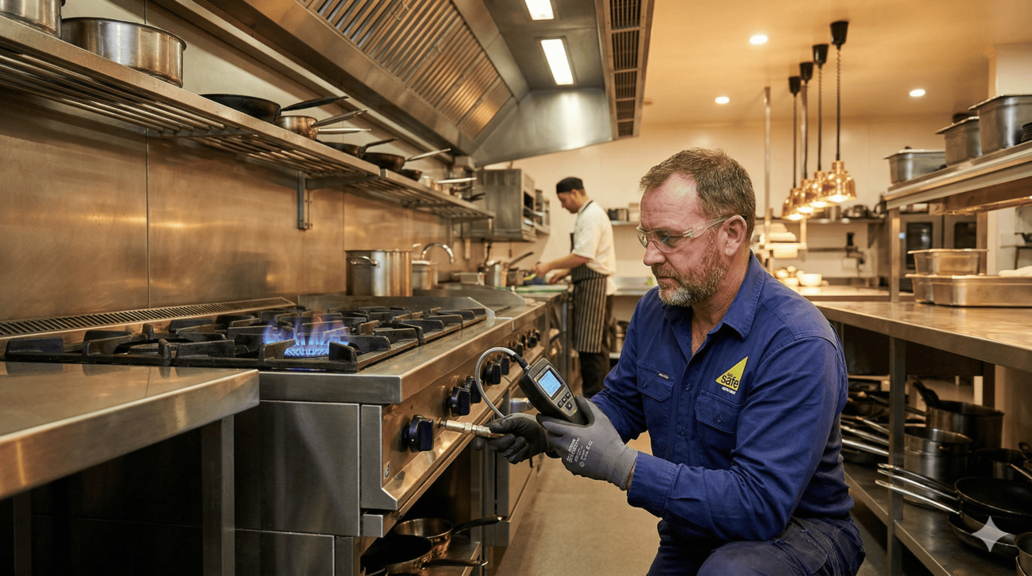
A Type A gas compliance inspection is systematic and covers every component of the kitchen’s gas system from the meter to the burner tip.
Gas Line Integrity
Pressure testing from the meter to each appliance connection point. The gas fitter tests for pressure drop across the system, identifying any leak, however minor. A minor gas leak in a commercial kitchen is not a maintenance item to schedule. It is a continuous ignition risk in a high-heat environment.
Appliance Condition
Each appliance is assessed against AS 5601 (Gas Installations). The inspection covers burner condition, ignition systems, flame failure devices, gas pressure at each appliance, and the physical condition of gas connections and flexible hoses. Appliances that do not meet AS 5601 requirements are recorded as non-conforming.
MODIFICATION RISK: A commercial kitchen appliance that has been modified (burner replaced, gas orifice drilled out, ventilation altered) is no longer operating within its certified configuration. This voids the appliance certification and potentially the kitchen’s insurance cover. Modified appliances must be assessed and re-certified before continued use.
Ventilation Compliance
AS 5601 specifies ventilation requirements for commercial gas installations. Inadequate ventilation is the most common failure point in commercial kitchen gas inspections. Kitchen modifications, the addition of new equipment, blocked or altered extraction systems, and changes to building layout all affect ventilation adequacy. The gas fitter assesses whether the current ventilation meets AS 5601 requirements for the installed gas load.
Emergency Shut-Off Valve Operation
The emergency gas shut-off valve must be accessible, clearly marked, operational, and known to kitchen staff. The inspector tests valve operation and confirms that the valve location is documented in the kitchen’s safety procedures. A shut-off valve that kitchen staff cannot locate or operate in an emergency defeats its purpose entirely.
Triggers for Mandatory Re-Certification
The annual inspection is the baseline obligation. Several events trigger mandatory re-certification outside the annual cycle.
| TRIGGER EVENT | COMPLIANCE ACTION REQUIRED | WHO CAN CERTIFY | TIMEFRAME |
|---|---|---|---|
| Annual obligation | Full Type A inspection + certificate | Type A licensed gas fitter | Prior to expiry |
| New appliance installation | Installation + commissioning certificate | Type A licensed gas fitter | Before first use |
| Tenancy change / change of use | Full gas system inspection + new certificate | Type A licensed gas fitter | Before trading |
| Post-repair (gas line or appliance) | Pressure test + re-certification | Type A licensed gas fitter | Before reconnection |
| Insurance renewal audit | Current certificate (no older than 12 months) | Type A licensed gas fitter | Prior to renewal |
| Council or WorkSafe inspection | Current certificate + logbook on premises | Type A licensed gas fitter | On demand |
| New gas appliance added | Certificate updated to include new appliance | Type A licensed gas fitter | Before first use |
The tenancy change trigger is the most commonly missed. When a hospitality venue changes hands, the incoming operator frequently assumes the previous operator’s gas compliance certificate carries over. It does not. The new operator must obtain a fresh certificate covering the full gas system and every connected appliance before commencing trading. A certificate issued to a previous tenant has no standing for the current operator’s insurance or legal compliance.
LEASE RENEWAL NOTE: Commercial lease renewals increasingly require current gas compliance certification as a condition of renewal. Landlords and property managers are adding gas certificate currency to lease compliance schedules alongside electrical safety and fire system obligations.
The Insurance Void Clause Most Operators Have Not Read
Standard commercial kitchen insurance policies condition cover on statutory compliance. The policy wording varies between insurers, but the effect is consistent: the insured must comply with all applicable laws, regulations and Australian Standards relevant to the insured premises.
A lapsed gas compliance certificate is a breach of statutory compliance under the Gas Supply Act 2003. When a gas-related incident occurs in a commercial kitchen, the insurer’s first question is whether the gas compliance certificate was current at the time of the incident. If it was not, the insurer has grounds to dispute the claim under the statutory compliance condition.
This is not a theoretical risk. It is the standard claims investigation procedure for gas-related incidents in commercial premises.
INSURANCE EXPOSURE: A commercial kitchen operator with a lapsed gas compliance certificate is not merely non-compliant with Queensland law. They are potentially operating without effective insurance cover for the most catastrophic risk their business faces. A gas incident in an uninsured kitchen exposes the operator to the full cost of the incident, including third-party injury claims, property damage, and business interruption across affected premises.
Some insurers now require annual gas compliance certificate verification at policy renewal. The certificate must be current and issued by a Type A licensed gas fitter. Operators who cannot produce a current certificate at renewal face higher premiums, restricted cover, or outright refusal to renew.
Multi-Venue Operations: The Single Contractor Model
A hospitality group running five venues under five separate gas contractors has five separate inspection cycles, five separate document trails, and five separate points of failure. When one certificate lapses, nobody in the group notices until an insurer or inspector asks for it.
A single contractor managing all venues consolidates the compliance programme into one schedule, one document trail, and one relationship. Scheduled annual inspections across multiple venues are priced more efficiently than reactive individual bookings. The contractor knows every kitchen, every appliance register, every certificate expiry date.
For operators managing three or more venues, the single contractor model is not a convenience. It is a compliance management strategy that reduces the probability of a certificate lapsing unnoticed.
TRI Plumbing | QBCC Licence 46389
Type A gas work authorisation. Licensed gas fitters across Brisbane, Gold Coast and Mackay. Scheduled annual compliance programmes for multi-venue hospitality operators. One contractor, one schedule, one document trail.
Book a Commercial Kitchen Gas InspectionWhat to Expect During a Commercial Kitchen Gas Inspection
A commercial kitchen gas inspection takes between one and three hours depending on the number and type of appliances installed. Schedule the inspection outside peak service hours. Early morning or between lunch and dinner service are the most practical windows.
Before the inspection:
- Confirm the gas fitter’s Type A authorisation number
- Have the previous gas compliance certificate available for reference
- Clear access to all gas appliances, connections and the gas meter
- Identify and confirm the location of the emergency gas shut-off valve
- Ensure all appliances are in their normal operating configuration
During the inspection:
The gas fitter works through each appliance systematically. Gas line pressure testing, individual appliance checks against AS 5601, ventilation assessment, and emergency shut-off valve testing. Where non-conformances are identified, the gas fitter records the defect and the required rectification.
After the inspection:
Where all appliances and gas infrastructure meet AS 5601 requirements, the gas fitter issues the compliance certificate on-site. Retain the original certificate on the premises and keep a digital copy in the business’s compliance records. Where non-conformances are identified, the gas fitter provides a written report detailing the required rectification before a certificate can be issued.
Ready to schedule your kitchen gas compliance?
TRI Plumbing holds Type A gas work authorisation under QBCC Licence 46389. Annual compliance programmes across Brisbane, Gold Coast and Mackay. View our gas fitting capabilities.
Frequently Asked Questions
How often does a Queensland commercial kitchen need gas compliance certification?
Annual certification is the baseline requirement under the Gas Supply Act 2003. Beyond the annual cycle, re-certification is triggered by new appliance installation, tenancy change, post-repair reconnection, insurance renewal audit, or council and WorkSafe inspection. The annual cycle runs from the date of the previous certificate, not the calendar year.
What is a Type A gas licence in Queensland?
A Type A gas work authorisation covers the installation, servicing and certification of commercial kitchen gas equipment: cooktops, ranges, fryers, char grills, salamanders, ovens, wok burners and commercial coffee equipment. Only a gas fitter holding Type A authorisation can legally issue the compliance certificate required by Queensland law and by commercial kitchen insurance policies.
What happens if a commercial kitchen gas compliance certificate lapses?
A lapsed certificate creates immediate exposure on multiple fronts. Insurance cover for gas-related incidents is potentially voided under the statutory compliance condition in most commercial kitchen policies. WorkSafe Queensland can issue improvement or prohibition notices. Council can issue findings affecting trading approval. The operator carries personal liability for any incident occurring during the lapsed period.
Does a change of ownership or tenancy require a new gas compliance certificate?
Yes. A gas compliance certificate issued to a previous operator does not transfer to a new operator or tenant. The incoming operator must obtain a new certificate covering the full gas system and all appliances before commencing trading. This is the most commonly missed trigger for re-certification.
Can TRI Plumbing manage gas compliance across multiple hospitality venues?
TRI Plumbing holds QBCC Licence 46389 with Type A gas work authorisation. Our licensed gas fitters service commercial kitchens across Brisbane, Gold Coast and Mackay. We operate scheduled annual compliance programmes for multi-venue operators, consolidating all venues under one inspection schedule, one document trail and one contractor relationship.
What is the difference between a gas compliance certificate and a gas safety check?
A gas compliance certificate is a formal legal document issued under AS 5601 and the Gas Supply Act 2003 by a Type A licensed gas fitter following a systematic inspection of the entire gas system and every connected appliance. A gas safety check is an informal term with no defined legal standard, no prescribed scope and no standing with insurers or regulators. Only the certificate satisfies Queensland's legal and insurance requirements.