
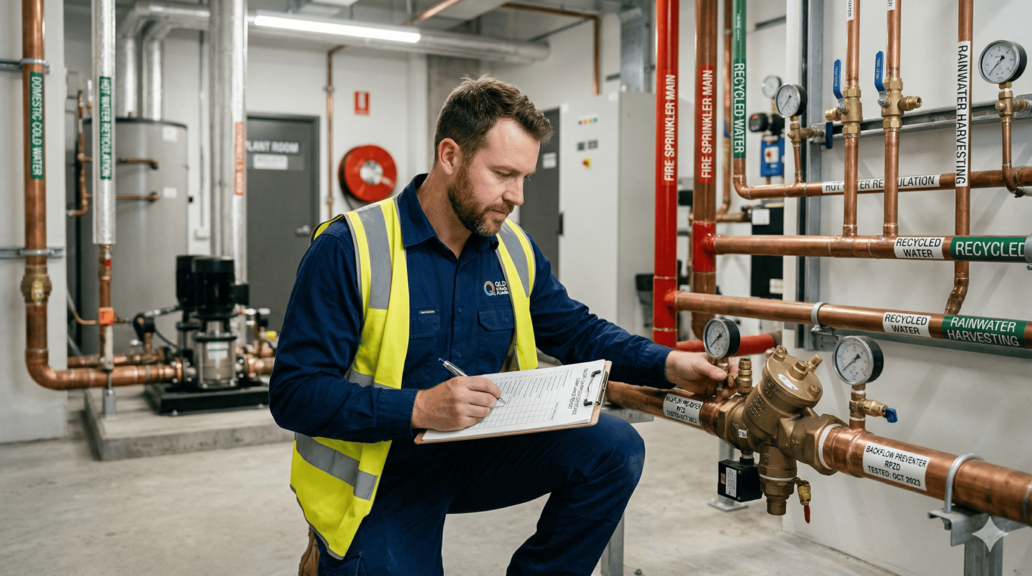
LIABILITY WARNING
Most body corporates in Queensland discover their plumbing compliance gaps during an insurance claim, a council inspection or a tenant injury. By that point the question is no longer whether the obligation existed. It is who is personally liable for ignoring it.
Backflow prevention testing is the most commonly missed compliance obligation in Queensland strata. Not the most obscure. Not the most technically complex. The most commonly missed.
The paperwork exists, the obligation is clearly defined under AS/NZS 2845.1 and the Queensland Plumbing and Wastewater Code, and the liability for non-compliance sits with the body corporate committee. Not the contractor who last serviced the building, not the strata manager, not the insurer.
The committee. Personally.
This guide covers every plumbing compliance obligation Queensland strata managers and body corporate committees carry. For each: the obligation, the relevant instrument, the testing frequency, who must certify, and what happens when the paperwork is not current.
The compliance gap does not create itself. It accumulates while nobody is looking, until something fails and everyone starts looking at once.
The Complete Queensland Strata Plumbing Compliance Obligations
| OBLIGATION | FREQUENCY | WHO CERTIFIES | CONSEQUENCE | INSTRUMENT |
|---|---|---|---|---|
| Backflow Prevention Testing | Annual (minimum) | QBCC licensed plumber | Insurance void, council penalty | AS/NZS 2845.1 | Qld Plumbing and Wastewater Code |
| Type B Gas Appliance Inspection | Annual | Licensed gas fitter | Liability exposure, insurance dispute | Gas Supply Act 2003 (Qld) |
| Fire Sprinkler System Plumbing | 6-monthly / Annual | QBCC licensed contractor | Non-compliant building certification | AS 1851-2012 |
| Hose Reel Certification | 6-monthly / Annual | QBCC licensed contractor | Fire safety non-compliance | AS 1851-2012 |
| Hot Water Temperature Compliance | Annual | Licensed plumber | Legionella risk, duty of care liability | AS/NZS 3500.4 | QBCC Code |
| Legionella Risk Management (10+ units) | Annual assessment | Accredited assessor | WHS Act breach, personal liability | Public Health Act 2005 (Qld) |
REGULATION NOTE: All regulatory references should be verified against current Queensland legislation and standards. Standards Australia references (AS/NZS) are updated periodically. Confirm currency with your QBCC licensed contractor before relying on this table for compliance decisions.
Backflow Prevention: The Obligation Nobody Audits Until It Is Too Late
Backflow prevention devices stop contaminated water from re-entering the potable water supply. In a strata complex, a single failed or untested backflow prevention device can contaminate the water supply serving every unit in the building. The public health consequence is significant. The liability consequence for the body corporate committee is more significant.
Queensland’s Plumbing and Wastewater Code, administered under the Plumbing and Drainage Act 2018, requires that all registered backflow prevention devices are tested annually by a QBCC licensed plumber. The results must be recorded in a register and available for inspection. Devices rated as high-hazard installations may require more frequent testing under AS/NZS 2845.1.
What Happens When Testing Lapses
An untested backflow prevention device creates a documented compliance failure. When a water quality incident, a tenant illness or a council inspection surfaces that failure, the body corporate committee cannot point to the contractor and say the obligation was theirs. The obligation to maintain the register sits with the building owner. In strata, that is the body corporate as a legal entity, and the committee members who authorised the maintenance budget.
INSURANCE NOTE: Some Queensland insurers include plumbing compliance certificate currency as a condition of cover for water damage claims. A body corporate without current backflow testing records may find a significant water damage claim disputed on compliance grounds. Verify your policy wording with your insurer.
The practical fix is straightforward: a QBCC licensed plumber carries out annual testing, issues a compliance certificate, and the certificate is filed in the building’s compliance register. The cost of annual testing is marginal relative to the cost of a disputed insurance claim or a legal action by an affected tenant.
Gas Safety Certificates: Type B Appliances and Annual Obligations
Type B gas appliances are those installed as part of a building’s permanent gas infrastructure: commercial boilers, central heating systems, gas-fired hot water systems serving multiple units, and communal cooking facilities. Under the Gas Supply Act 2003 (Queensland), Type B gas appliances require annual inspection and certification by a licensed gas fitter.
The Inspection Scope
A Type B gas appliance inspection covers:
- Gas line integrity from the meter to each appliance
- Appliance condition and operational safety checks
- Ventilation adequacy for gas combustion and exhaust
- Emergency shut-off valve operation and accessibility
- Pressure testing where required by appliance age or condition
The inspector issues a compliance certificate upon satisfactory completion. Where defects are identified, the inspector issues a non-conformance notice. The body corporate is required to address notified defects within the timeframe specified.
Strata Buildings With Communal Gas Infrastructure
Strata complexes with communal gas infrastructure carry a higher compliance obligation than buildings where individual tenancies manage their own connections. The body corporate’s responsibility extends to every point on the communal gas network.
A strata manager running 10 complexes under one licensed contractor with a documented compliance schedule has a defensible liability position. The same manager running 10 complexes under six different contractors with inconsistent paperwork does not.
Fire System Plumbing: AS 1851-2012 and the Building Certification Risk
Fire sprinkler systems and fire hose reels in Queensland strata buildings are subject to maintenance obligations under AS 1851-2012. The plumbing component of these systems is a QBCC licensed plumbing contractor obligation.
AS 1851-2012 specifies maintenance frequencies for different system types. Sprinkler systems require 6-monthly and annual maintenance tasks. Hose reels require 6-monthly inspection. The maintenance must be carried out by a licensed contractor and recorded in a system logbook that remains on-site.
The Building Certification Consequence
A Queensland strata building with a lapsed fire system maintenance record carries a non-compliant building certification risk. The Queensland Development Code and the Building Act 1975 impose obligations on building owners to maintain essential safety measures. A non-compliant certification can affect the building’s insurance, its sale or refinancing, and in extreme cases trigger an order requiring occupant relocation during rectification.
PRACTICAL NOTE: Fire sprinkler system plumbing maintenance and general plumbing compliance work can be scheduled together under a single contractor where the contractor holds both QBCC plumbing and fire protection endorsements. This reduces the number of compliance relationships the body corporate manages.
Hot Water System Compliance and Legionella Risk
Hot water systems in Queensland strata buildings are subject to temperature compliance requirements under AS/NZS 3500.4 and the Queensland Plumbing and Wastewater Code. The requirement is that hot water is stored and delivered at temperatures that prevent Legionella growth while protecting against scalding.
For strata buildings with central hot water systems serving 10 or more units, Queensland’s Public Health Act 2005 imposes a specific obligation to manage Legionella risk. This requires an annual risk assessment by an accredited assessor, a documented Water Safety Plan, and maintenance records demonstrating the plan is being implemented.
Why This Obligation Is Frequently Missed
The Legionella management obligation applies to buildings with warm water systems that can support bacterial growth, typically those with centralised systems where water sits at temperatures between 20 and 45 degrees Celsius for extended periods. Many older strata buildings with ageing central hot water infrastructure fall into this category without the committee being aware the obligation has been triggered.
A body corporate that has never had a central hot water system assessed for Legionella risk, and whose system age and configuration suggest the obligation applies, has an unquantified liability sitting in the plant room.
WHS EXPOSURE: Queensland’s Work Health and Safety Act 2011 imposes a duty of care on body corporates as persons conducting a business or undertaking (PCBUs) in relation to communal facilities and common areas. A Legionella incident in a communal hot water system can trigger WHS investigation and potential prosecution of committee members as officers of the body corporate.
The 2011 Queensland Floods: What Compliance Records Determined
Queensland’s 2011 flood events tested strata building compliance infrastructure across Brisbane’s inner suburbs and river precincts. The insurance claims process that followed separated buildings with documented maintenance records from those without.
Buildings with current compliance certificates had a documented pre-event condition record. Their claims assessors could establish the pre-flood state of building services, attribute damage to the flood event, and process claims against clear baselines.
Buildings without current compliance documentation faced contested claims. Without a documented pre-event condition, assigning responsibility for damage between flood impact and prior maintenance failures becomes a dispute rather than an assessment. Claims that should have been straightforward took months or years to resolve. In some cases, body corporate committee members faced personal exposure to costs that the building’s insurance would have covered had the compliance record been current.
The 2011 floods did not create the compliance failures they exposed. They simply made the cost of those failures unavoidable and immediate.
The same dynamic applies to any insured event. The insurance claim process interrogates the building’s maintenance history. A complete compliance record is not just a regulatory obligation. It is an insurance asset.
Building the Compliance Register: What It Must Contain
A Queensland strata building’s plumbing compliance register should contain, at minimum:
- Backflow prevention device register — device location, hazard rating, test dates, test results, certifying contractor QBCC licence number
- Gas compliance certificates — one per Type B appliance, current within 12 months, signed by licensed gas fitter with licence number
- Fire system maintenance logbook — on-site at the building, entries for every 6-monthly and annual service
- Hot water system compliance record — temperature test results, thermostat calibration records, annual Legionella assessment (where applicable)
- Water Safety Plan — for centralised systems serving 10 or more units, current within 12 months
- Non-conformance notices and rectification records — every identified defect, the rectification instruction, and the completion sign-off
STRATA MANAGER NOTE: The strata manager’s obligation is to advise the body corporate of compliance requirements and facilitate access for licensed contractors. The legal obligation to maintain compliance rests with the body corporate. Where a strata manager has failed to advise on compliance obligations, legal advice should be sought on responsibility allocation.
Single Contractor vs. Multi-Contractor Compliance Management
A strata complex managed under multiple trade contractors for different compliance obligations carries a coordination risk that compounds as the number of contractors increases. Backflow testing with Contractor A, gas certification with Contractor B, fire system plumbing with Contractor C, and hot water compliance with Contractor D means four separate certificate cycles, four separate document trails, four separate contractor relationships to manage, and four separate points at which a certificate can lapse without the others catching it.
A single QBCC licensed contractor holding coverage across plumbing, gas and fire system plumbing produces one compliance schedule, one document trail, and one relationship. When a certificate is due, one call is made. The contractor knows the building.
Ten complexes under one contractor with a documented annual schedule is a manageable compliance programme. Ten complexes under six contractors with inconsistent scheduling is a liability waiting for a trigger.
Consolidate your strata compliance.
TRI Plumbing holds QBCC Licence 46389 covering plumbing, gas and roofing. Backflow, gas, fire systems and hot water under one compliance schedule across Brisbane, Gold Coast and Mackay. View our strata capabilities.
Frequently Asked Questions
How often does backflow prevention equipment need testing in Queensland strata?
Under AS/NZS 2845.1 and the Queensland Plumbing and Wastewater Code, backflow prevention devices require annual testing by a QBCC licensed plumber. High-hazard installations may require more frequent testing. The body corporate is responsible for maintaining the testing register and making it available for inspection.
Who is liable if plumbing compliance lapses in a Queensland strata complex?
Liability for plumbing compliance rests with the body corporate as the legal entity responsible for common property and shared infrastructure. Committee members can face personal liability for compliance failures that result in injury, property damage, or insurance disputes. Legal advice should be sought for specific liability questions.
What is a Water Safety Plan and does our strata building need one?
A Water Safety Plan documents the management controls for Legionella risk in a building’s water systems. Under Queensland’s Public Health Act 2005, strata buildings with centralised warm water systems serving 10 or more units are required to have a current Water Safety Plan prepared by an accredited assessor.
Can TRI Plumbing manage all our strata compliance obligations under one contractor?
TRI Plumbing holds QBCC Licence 46389 covering plumbing, gas and roofing. Our licensed plumbers and gas fitters can carry out backflow prevention testing, gas appliance certification, hot water system compliance, and general plumbing maintenance under a single contractor arrangement across Brisbane, Gold Coast and Mackay.
What should we do if a non-conformance notice has been issued for our building?
A non-conformance notice identifies a specific defect and a required rectification timeframe. The body corporate is required to engage a licensed contractor to carry out the rectification and obtain a completion sign-off. Document the notice, the rectification instruction, and the completion record in the building’s compliance register.
Does the strata manager or the body corporate carry compliance responsibility?
The body corporate carries the legal compliance obligation. The strata manager’s role is advisory and administrative. For specific questions about responsibility allocation between strata managers and committees, legal advice is required.